Children Becoming Content, Parents Becoming Moderators: The Scientific Cost of Digital Childhood.
As we have stepped completely into the digital era, our day-to-day life is now deeply dependent on electronic devices. However, this dependence did not begin overnight. Even in the late 20th century, households gradually adopted machines to reduce human effort—television and radio for infotainment, washing machines for laundry, refrigerators for food preservation, and similar conveniences. Back then, these devices worked in isolation. They required direct human instructions and functioned only when we consciously operated them. The real shift happened in recent years, when these everyday gadgets became interconnected through a global network called the Internet. Today, with a single tap on a smartphone or tablet, we can control lights, televisions, cameras, speakers, and even kitchen appliances. This interconnected ecosystem is popularly known as the Internet of Things (IoT)—a system where devices are no longer passive tools, but semi-autonomous entities capable of collecting data, learning preferences, and making limited decisions on their own.
It is one of the greatest achievements of humankind that, as we evolved over time, we continuously shaped the world around us to make life easier and more comfortable. Humans invented, built, and innovated countless tools—not to replace themselves, but to reduce physical strain and simplify daily life. Most of these innovations were designed to be non-invasive, easing effort without interfering deeply with human movement, thought, or emotion. In this journey of progress, mobile phones emerged as one of the most remarkable tools. In their early days, they served a clear and limited purpose: communication. They helped people stay connected with family, friends, offices, industries, and essential personal networks, even across distant, remote, or difficult geographical conditions.
However, as time evolved, mobile phones evolved with it. What began as a portable communication device gradually transformed into something far more intimate. Today, a mobile phone is no longer just a tool—it has become a digital persona of its user. It has the power to unmask an individual more effectively than any magician ever could, revealing habits, preferences, impulses, and vulnerabilities. It records almost every aspect of human life: whom we talk to, what we watch, what we search for, how long we stare, what excites us, and even what we subconsciously avoid. In many ways, it reflects not who we claim to be—but who we truly are.
In recent years, the entire world faced an unimaginable and unplanned disaster—the COVID-19 pandemic. The coronavirus spread at an unprecedented speed, attacking the human respiratory system and overwhelming immune responses, particularly among the elderly and medically vulnerable. The scale of human loss was devastating. Millions of lives were lost, and countless families were left grieving loved ones. The pandemic altered not just public health systems, but the emotional and social fabric of human society.
However, this tragedy also serves as a background to a quieter transformation that followed. To contain the spread of the virus, governments across the world imposed complete lockdowns. Individuals were confined to their homes, allowed to step outside only for emergencies and essential needs such as food and medicines. All other commercial and social activities came to a sudden halt.
For most people, this marked the beginning of an unfamiliar reality—prolonged isolation, disrupted routines, and an excess of unstructured time. Boredom, anxiety, and curiosity began to coexist. In this environment, many people started recording short videos—initially as a way to document memories, cope with isolation, or simply pass time. These videos were uploaded to social media platforms without any professional intent.
What began as casual content soon evolved into something larger. As work and education shifted entirely to remote modes, individuals found themselves with both access and opportunity. Gradually, video logging—or vlogging—emerged as a widespread cultural phenomenon. Some creators gained recognition, others gained followers, and for many, creative output reached its peak during this period. Social media platforms, along with their owners and stakeholders, quickly recognized the commercial potential of this surge in user-generated content.
To capitalise on this behavioural shift, platforms introduced dedicated formats such as short videos, reels, and shorts—typically ranging from 30 seconds to 90 seconds—designed for rapid consumption and endless scrolling. This shift did not merely create a trend; it gave rise to a new digital economy. Between 2020 and 2026, short-form video content evolved into a multi-billion-dollar industry. Recent studies underscore an unprecedented surge alongside this evolution, with smartphone usage among adolescents reaching 95%, and many individuals dedicating upwards of three hours daily to navigating these highly stimulating platforms (Bozzola et al., 2022).
This transformation triggered a new kind of rat race—one driven by instant fame, visibility, and monetisation, often achieved with comparatively minimal effort. In many cases, the perceived returns appeared disproportionately high—sometimes multiple times greater than those offered by conventional, even high-paying, professional careers such as engineering or information technology.
The appeal was understandable. For many young individuals—especially extroverts or those simply seeking a platform to express themselves—social media offered an open stage. Singing, drawing, dancing, cooking, storytelling, comedy, and humour found instant audiences. Creativity flourished, and for a while, the ecosystem appeared healthy and empowering.
Up to this point, everything seemed largely acceptable.
However, the problem began when this pursuit of content creation gradually shifted into an unchecked obsession with recognition, virality, and rapid monetisation. What started as expression turned into performance; what began as creativity evolved into compulsion. The consequences were no longer limited to individuals. Concerns began emerging at the family level and, eventually, at the societal level—when boundaries blurred, judgement weakened, and content creation started slipping out of control in the pursuit of fame and fast money.
In recent times, I have personally encountered deeply disturbing content while browsing YouTube Shorts and Instagram Reels. A significant portion of this content involves minors and underage teenagers participating in sexualised or romantically aggressive narratives, often glorifying toxic ideas such as forced pursuit, emotional coercion, or violence framed as heroism.
Such portrayals are not only misleading but dangerously unhealthy. They convey distorted messages to toddlers, pre-adolescent children, teenagers, and other emotionally immature audiences who lack the cognitive maturity to differentiate fiction from acceptable real-world behaviour.
Even more concerning is the growing presence of dark, suggestive, and double-meaning content that normalises inappropriate themes under the guise of humour or creativity. The long-term psychological implications of repeated exposure to such material cannot be ignored. Research indicates that the prevalence of social media addiction among teenagers has climbed to as much as 20% globally (Amirthalingam & Khera, 2024). Much of this is driven by variable reward systems that establish dopamine-driven feedback loops, compelling young minds to endure endless scrolling for validation (Amirthalingam & Khera, 2024). Consequently, up to 14% of adolescents currently display clinical signs of addiction, significantly correlating with heightened anxiety and lowered self-esteem (Ciacchini et al., 2023).
Several reputed news media reports have highlighted alarming examples from social media platforms. In some cases, adults have been seen smoking, dancing, or performing stunts while holding infants barely six months to a year old. In others, caregivers have recorded reels involving children placed dangerously close to open wells, rooftops, or other life-threatening environments.
These acts are not expressions of creativity; they are calculated risks taken for outrage-driven visibility. The potential for serious injury or fatal consequences is real, yet the pursuit of instant reach, reactions, and fleeting fame appears to override basic responsibility and child safety.
 Courtesy: hindustantimes.com
 Courtesy: India Today

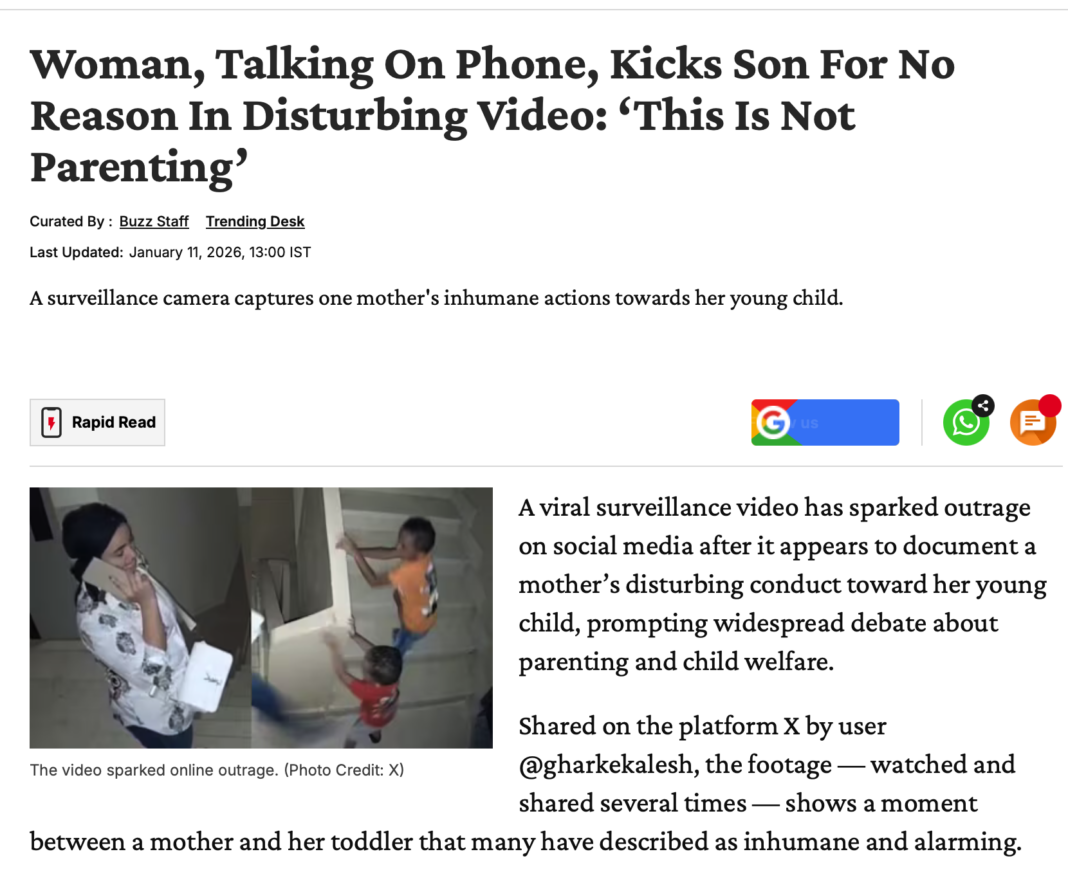
 Courtesy: abplive.com
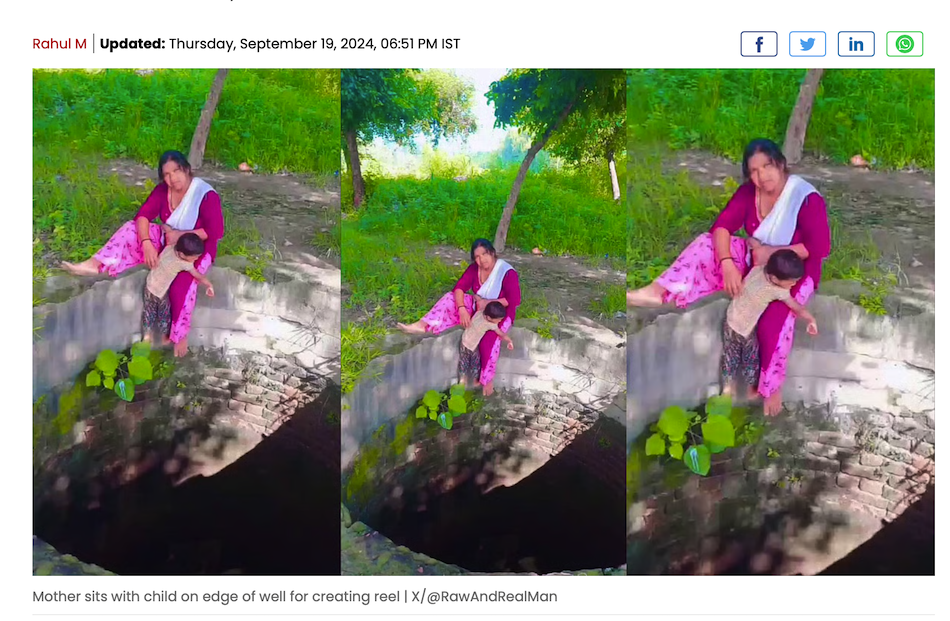 Courtesy: www.freepressjournal.in
The examples mentioned above are, unfortunately, only a small fraction of the content currently circulating on short-form video platforms. Much of what I encountered is far more disturbing in nature—so explicit and ethically troubling that sharing screenshots or direct links would itself amount to amplifying harm.
There are numerous instances where adolescents below the age of 18—or barely crossing into early adulthood—are producing content laden with overtly sexualised, double-meaning language. In parallel, some of these same creators are seen participating in romanticised or emotionally suggestive reels alongside children under the age of ten. Such contradictions are not merely inappropriate; they reflect a deeply troubling collapse of moral and developmental boundaries.
Even more alarming are cases highlighted across online discussions and media reports where creators publicly present themselves as biological mother-son duos while producing highly suggestive, borderline pornographic content. Although the individuals involved may be legally adults, the deliberate emphasis on familial relationships—explicitly displayed on screen—combined with sexually coded behaviour, creates an environment of psychological discomfort and ethical violation.
This form of content may not violate the letter of age-based legal definitions, but it unquestionably violates social responsibility. It normalises deeply unhealthy associations and risks distorting the emotional and relational frameworks of young viewers who are still forming their understanding of family, intimacy, and consent.
What remains particularly troubling is the selective outrage within public discourse. Scenes in films—often contextual, fictional, or symbolic—are subjected to intense scrutiny and censorship, while explicit, algorithm-amplified content on social media platforms frequently escapes sustained criticism. This inconsistency raises serious questions about the priorities of regulators, activists, and digital platforms alike.
In this context, the recent steps taken by the Australian government deserve genuine appreciation. Australia has introduced clear and enforceable rules restricting social media access for pre-teens and teenagers, recognising that children need protection from algorithm-driven platforms long before they need digital popularity. The intent is simple but powerful: childhood should not be treated as raw material for engagement metrics.
This decision reflects a rare clarity—that not every technological possibility must be socially acceptable, and not every form of “freedom” is healthy at every age.
Closer home, similar concerns have begun to surface at the policy level. Recently, Sudha Murthy, Member of Parliament in the Rajya Sabha, raised alarms over the growing exploitation of children on social media platforms, stressing that children should not be reduced to content for views, likes, or monetisation. Her remarks echo what many parents, educators, and observers have been feeling for some time—but often hesitate to say aloud.
If a country like Australia can take a firm stand to safeguard its younger generation, one is compelled to ask why similar protections cannot be thoughtfully designed and implemented in India—where the scale of exposure, population, and vulnerability is arguably far greater.
Technology, after all, is a human creation. And with creation comes responsibility—not just for governments and platforms, but for all of us as a society. The question is no longer whether regulation is needed, but whether we are willing to act before irreversible harm becomes normalized.
This discussion is not an argument against creativity, expression, or technology itself. It is a reminder that every powerful tool demands proportionate responsibility. When children become participants in an unregulated attention economy, the cost is paid not in likes or views, but in emotional development, boundaries, and long-term psychological well-being.
As societies, we regulate what children eat, what they watch, and where they go—because we recognize vulnerability. Digital spaces cannot remain the lone exception. The responsibility does not rest on governments alone, nor solely on platforms, but equally on parents, communities, and audiences who reward such content with attention.
There is another uncomfortable truth that must be acknowledged—one that does not involve influencers, algorithms, or platforms alone, but begins inside our own homes.
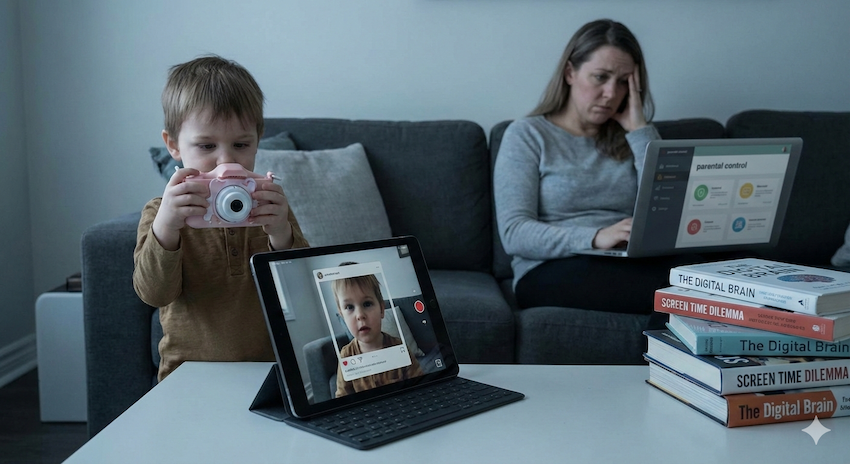
In many households today, children are handed mobile phones not out of curiosity, but out of convenience. Parents, overwhelmed by work, deadlines, and daily pressures, often rely on screens as temporary caretakers—to keep children busy, quiet, and occupied while “important work” gets done. Caregivers increasingly lean on screen time to soothe children who exhibit emotional and behavioral dysregulation (Griffith et al., 2024).
At first glance, this arrangement appears harmless. A cartoon playing in the background, a phone streaming videos, or a television left on for hours seems like a small compromise in a busy life. Yet what is rarely questioned is what children are actually watching, how long they are watching, and what ideas are being quietly absorbed.
Unlike earlier generations, today’s visual content is rarely neutral. Television shows, films, cartoons, and online videos are carefully packaged with subtle messaging—commercial interests, behavioural cues, ideological undertones, and social narratives—designed for adult cognition, but consumed by untrained, developing minds.
When such exposure happens without supervision or contextual guidance, children do not merely watch content—they internalize it. Values, relationships, gender roles, aggression, entitlement, and even distorted notions of heroism are absorbed long before critical thinking has a chance to develop.
This is not an accusation against parents, but a reflection of a system that rewards distraction over engagement. However, the consequences of this convenience-driven parenting are cumulative. Longitudinal evidence clearly demonstrates that greater exposure to screens during early childhood predicts later externalizing behavior problems, including severe inattention, aggression, and difficulties with self-regulation (Griffith et al., 2024). A child pacified by screens today may grow into an adolescent conditioned by instant stimulation, emotional shallowness, and reduced tolerance for boredom or effort.
Technology was never meant to replace parental presence. When screens become babysitters and algorithms become silent educators, the cost is paid not immediately—but years later, in behavior, attention, and emotional resilience.
The question before us is simple: do we want a generation raised by families—or by algorithms?
True nation-building relies on the cognitive and emotional resilience of its youth—a foundation built through rigorous education, critical thinking, and mindful upbringing, not algorithmic conditioning. Ensuring that technology serves our society as a constructive tool rather than an invisible architect of childhood is the defining responsibility of our time.
References
Amirthalingam, J., & Khera, A. (2024). Understanding social media addiction: A deep dive. Cureus. https://doi.org/10.7759/cureus.72499 Cited by: 73
Bozzola, E., Spina, G., Agostiniani, R., et al. (2022). The use of social media in children and adolescents: Scoping review on the potential risks. International Journal of Environmental Research and Public Health, 19, 9960. https://doi.org/10.3390/ijerph19169960 Cited by: 940
Ciacchini, R., Orrù, G., Cucurnia, E., et al. (2023). Social media in adolescents: A retrospective correlational study on addiction. Children, 10, 278. https://doi.org/10.3390/children10020278 Cited by: 60
Griffith, S. F., Hart, K. C., Casanova, S. M., et al. (2024). Promoting healthy screen media use in young children with externalizing behavior problems through an adapted parenting intervention: Results of an open trial. Cognitive and Behavioral Practice. https://doi.org/10.1016/j.cbpra.2024.02.002 Cited by: 7